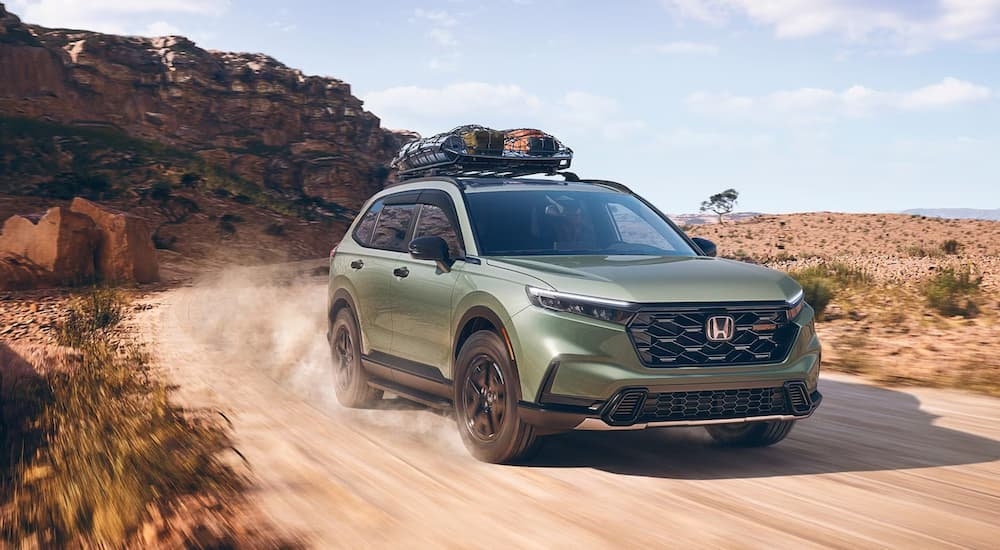
After nearly three decades of development, the Honda CR-V has achieved compact-crossover perfection. This SUV's well-rounded design has no obvious weak points, which means the CR-V is just as comfortable exploring light off-road terrain as it is navigating through highway traffic or comfortably accommodating five passengers and all of their gear on an extended road trip.
The CR-V was already a great compact crossover, but Honda hasn't stayed successful by coasting on past victories. A mid-cycle refresh sees the 2026 CR-V receive a comprehensive set of upgrades, including new-and-improved infotainment tech, an enhanced all-wheel drive system, and even a new off-road-ready TrailSport Hybrid trim that's designed to tackle the road less traveled while saving you some serious cash at the pump.
This crossover isn't the only 2026 compact to enjoy a mid-cycle makeover, though, as the Kia Sportage also gains a new exterior design, a fresh interior with a new steering wheel and dashboard, and cutting-edge tech such as a head-up display and remote parking assist. It's a thorough redesign that should make the Sportage a more enticing option for those seeking a reliable SUV, but can it compete with the CR-V? Let's dive into some key differences in the 2026 Honda CR-V vs 2026 Kia Sportage.
A Model of Efficiency
Fuel economy is often one of the essential factors that draws buyers to the crossover segment. While they might technically be classified as SUVs, crossover models tend to deliver a level of fuel efficiency closer to that of a sedan than to a larger, body-on-frame SUV. It might not be a dealbreaker for all drivers, but choosing an efficient vehicle is one of the easiest ways to reduce lifetime ownership costs while getting the most out of every trip to the gas station.
Just take the 2026 CR-V, for example. Honda's SUV is equipped with one of the thriftiest gas engines in the hotly contested segment, with the CR-V's 1.5L turbocharged I-4 offering up to an EPA-estimated 33 MPG on the highway.[a] The entry-level engine doesn't have any real competitors outside of Nissan's compact, the Rogue, and it leaves the Kia Sportage firmly in the rearview mirror in terms of efficiency.
The Sportage's 2.5L I-4 is not only significantly larger than the CR-V's base engine, but it also lacks a turbocharger. That's an odd choice in this day and age, and it puts a real damper on the Sportage's economic appeal. Kia's SUV delivers 28 MPG combined, but it gets particularly thirsty with all-wheel drive, which returns just 26 MPG combined. The situation isn't helped by the Sportage's traditional automatic transmission, which is inherently less efficient than the CR-V's continuously variable transmission (CVT).
If you're in the market for the most efficient CR-V or Sportage, both brands have you covered with hybrid powertrain options. The CR-V's 2.0L I-4 hybrid can log up to an EPA-estimated 43 MPG in the city, which is a modest improvement over the hybrid Sportage at 41 MPG in the city.[a] Kia also offers a plug-in hybrid (PHEV) version of the 2026 Sportage, but it's a little difficult to see the appeal, with the electrically-assisted SUV only managing 36 MPG combined.
No Shortage of Space
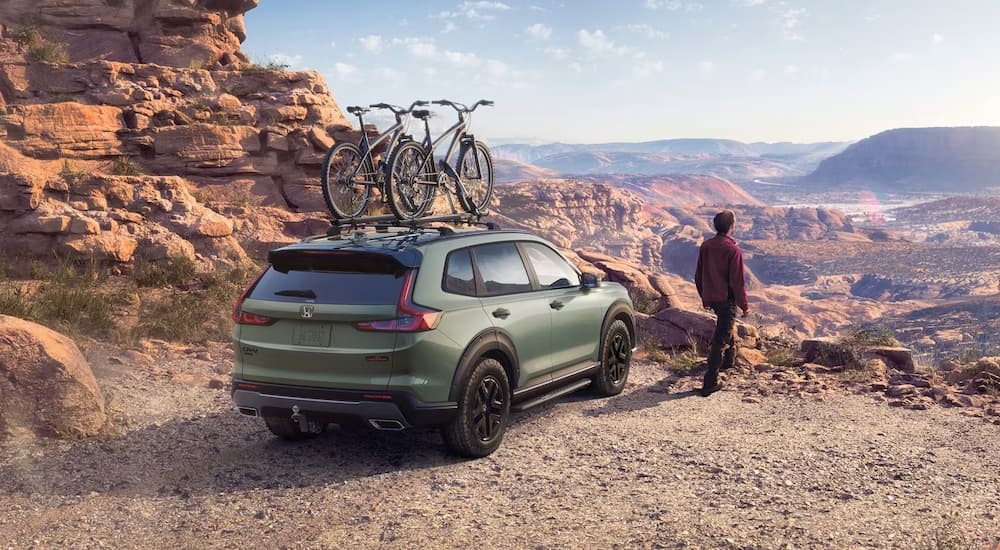
When discussing cargo and passenger space, the "compact" designation doesn't really do the 2026 Honda CR-V justice. While it might occupy the smaller end of the SUV spectrum, the CR-V is big on interior space. In fact, this compact leads much of its segment in terms of max cargo space, with up to 76.5 cu.ft. when the back row is folded down.
But it's not just the CR-V's size that has left so many drivers impressed; it's also the way that it's used. To make the most of every cubic foot, Honda has equipped the 2026 CR-V with clever storage solutions that make it feel much larger than its stated 76.5 cu.ft.
From a large center console between the front seats to a rear storage area with an adjustable load floor, the CR-V is ready to haul luggage, groceries, sports equipment, or whatever other supplies you might need to get through another busy week. The CR-V Hybrid sacrifices a little cargo space to accommodate its high-voltage battery, but it still places near the top of the pack with around 72 cu.ft.
So, how does the 2026 Sportage perform when compared to its Honda rival? It all depends on which powertrain you choose, though even the roomiest option still falls short of the spacious CR-V. The gas-powered Sportage leads the way with 74.1 cu.ft., but it's all downhill from there; the traditional hybrid isn't too far behind at 73.7 cu.ft., but the PHEV model could put a real strain on your next road trip with just 65.5 cu.ft.
A Suite of Smart Tech
Of all the advanced tech features in today's vehicles, infotainment systems tend to garner the most attention—and it's not hard to see why, with these displays serving as a convenient command center for many functions that aren't strictly related to driving.
From climate controls and entertainment to GPS navigation systems that seamlessly guide you to your destination and built-in apps that bring a new level of convenience to the daily driving experience, infotainment systems have launched an arms race in today's automotive market.
There are lots of ways to judge a vehicle's infotainment system, and while sheer size might be the most obvious, the overall user experience can't be discounted. Case in point, while the 2026 Kia Sportage technically beats the 2026 CR-V with a 12.3-inch infotainment display to the Honda's nine-inch screen, that doesn't tell the whole story.
While they might sound like the wave of the future, these touchscreen-based systems aren't always what they're cracked up to be. Both Honda's and Kia's infotainment systems offer relatively similar functionality, but the CR-V has a clear edge when it comes to adjusting various settings, accessing specific features, and overall processing power.
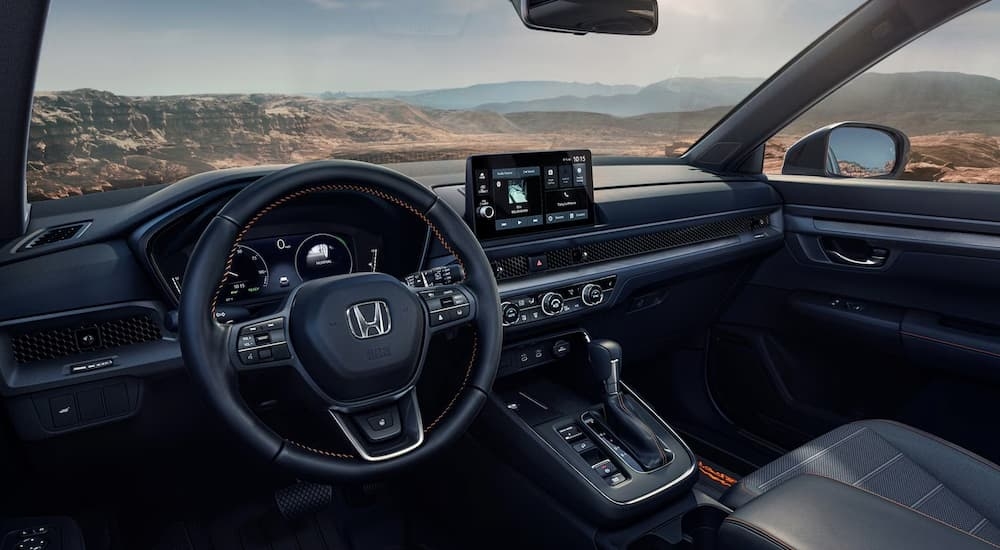
We'll start with one of the most basic functions you'll find on any dashboard: adjusting the audio volume or climate control system. Distracted driving is a major impediment to road safety, but it can be difficult to keep your eyes on the road when you have to navigate menus, icons, and settings to do something as simple as cranking up the volume or adjusting the AC.
While it lacks a dedicated knob or physical control for either function, the Kia Sportage fares better than most thanks to a standalone touch-sensitive panel located just below the main infotainment display. That said, drivers will still need to manually toggle between climate control and infotainment settings to bring up the correct interface. It's an extra step that's not just inconvenient, but also potentially unsafe.
Then there's the CR-V. Honda has bucked the digital-first trend that's gripped the auto industry as of late, outfitting its SUV with physical knobs and buttons that make for a safer, more intuitive, and more responsive experience when you're behind the wheel. Any screen-based system is bound to have some amount of lag, but you can avoid those frustrating delays when you choose the 2026 CR-V.
Enjoy Top-Notch Selection & Service at Hudson Honda
The CR-V's driver-focused design has brought it plenty of success over the last three decades, and that doesn't look like it'll be changing anytime soon. A new slate of advanced tech features, improved all-wheel drive, and a fresh set of wheel options keep this crossover competitive in a quickly changing market without losing sight of everything that's made the CR-V so great.
Its infotainment system is just one example of Honda's commitment to providing an elevated experience every time you step behind the wheel. While other brands might try to sell drivers on larger screens and other tech that do little to improve your daily commute, Honda has honed in on those features that truly make for a safer, more seamless driving experience.
Factor in the CR-V's impressive efficiency, spacious interior, and reputation for reliability, and it's tough to find a better bargain in the compact segment. When you're ready to experience an awesome crossover, the 2026 CR-V is waiting for you here at Hudson Honda.