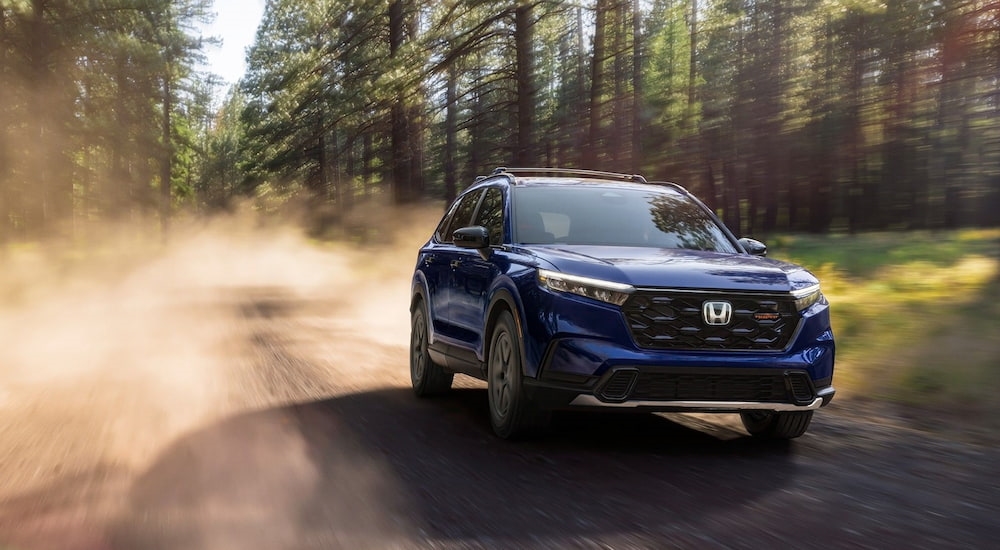
Both the Honda CR-V and the Toyota RAV4 are beloved compact SUVs that have dominated the American roadways for quite some time. Both Honda and Toyota have long-standing reputations as automakers that produce high-quality products designed to be efficient and reliable. So, how does anyone choose in the match-up of the 2026 Honda CR-V vs 2026 Toyota RAV4?
Ultimately, both SUVs are a solid choice for a variety of drivers. However, there are quite a few reasons why someone might choose the 2026 Honda CR-V over the 2026 Toyota RAV4. From comfort to diversity, there are a lot of things that drivers prefer about the CR-V. Take a look at some of the things that have motivated drivers to choose the Honda option time and again, and you may decide it's time to try it out for yourself.
What Are Your Power Priorities?
At first glance, the 2026 Toyota RAV4 clearly outperforms the 2026 Honda CR-V. While the Honda CR-V offers a choice of powertrains, all RAV4 models come standard with a hybrid engine/motor system.
The 2026 Honda CR-V's lineup includes three trim levels equipped with a 1.5L turbocharged I-4 engine that makes 190 hp (on gas alone) and four hybrid trim levels that come equipped with a 2.0L I-4 gas engine and hybrid system for an amplified total of 204 hp.
But what if you aren't interested in a hybrid vehicle at this time, or you find them cost-prohibitive? The RAV4 doesn't offer a trim without a hybrid power source, which contributes to it being one of the more expensive models in the compact SUV segment.
To compare apples to apples in this category, we then have to judge the CR-V's hybrid trims against those of the RAV4. For many drivers, the difference between the two vehicles may not be noticeable in most street-driving scenarios; however, depending on your driving route and style, this can result in a meaningful disparity. It all depends on your power priorities.
A Difference in Trim Lineups
Both the 2026 CR-V and the 2026 RAV4 are available in a range of trim levels to appeal to a diverse group of drivers. But finding the right option might be trickier with the RAV4.
The 2026 Honda CR-V's lineup includes LX, EX, EX-L, Sport Hybrid, TrailSport Hybrid, Sport-L Hybrid, and Sport Touring Hybrid trims. Of these, only the TrailSport Hybrid, Sport-L Hybrid, and Sport Touring Hybrid trims are offered exclusively with all-wheel drive.
The LX, EX, EX-L, and Sport Hybrid trims come standard with front-wheel drive, although all-wheel drive is available on all of them. In fact, for the 2026 model year, Honda has updated its Real Time AWD system to provide greater traction to all-wheel drive models, giving them greater stability on slippery or loose surfaces. Snow Mode is standard on all, taking advantage of low gear torque to navigate slick settings.
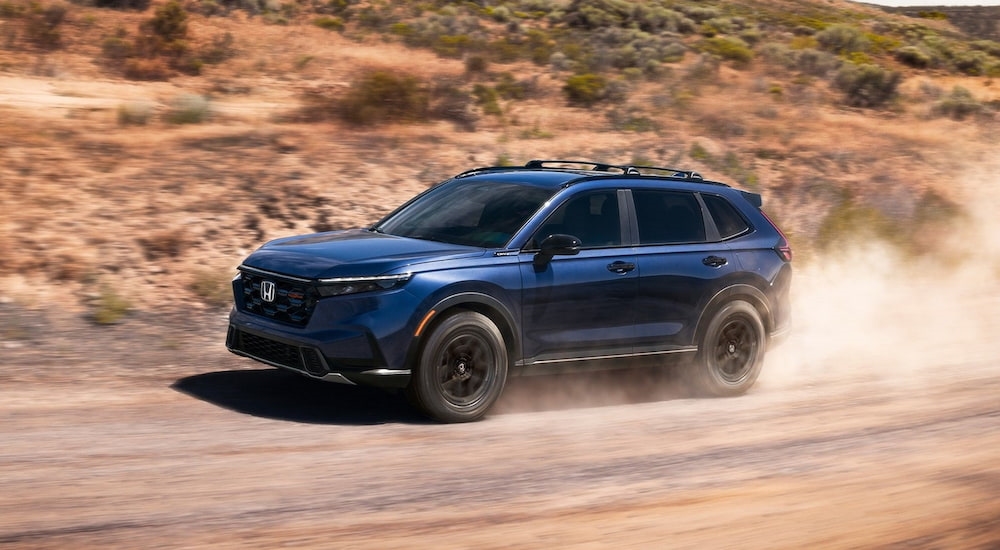
The Honda CR-V Hybrid TrailSport is considered the most rugged of the trim levels, offering features such as Hill Descent Control and all-terrain tires. All CR-V models have a ground clearance of 8.2 inches, which provides them with space to clear potholes, puddles, and unmaintained roads.
The 2026 Toyota RAV4's trim lineup includes the LE, SE, XLE Premium, Woodland, XSE, and Limited. Of these, front-wheel drive is offered as an option only on the LE, SE, and XLE trims. All 2026 RAV4 trims have a ground clearance of 8.1 inches, which is just shy of every CR-V, although the 2026 RAV4's Woodland trim tries to overcome this in its response to Honda's TrailSport trim level, in addition to adding all-terrain tires.
Every 2026 RAV4 has roof rails, which is no surprise given that every CR-V Hybrid has them. Toyota's model likewise makes Snow Mode available on all-wheel drive models.
Staying Connected on the Road
The 2026 Honda CR-V and the 2026 Toyota RAV4 are similar in size and shape, which would lead drivers to believe they offer a comparable driving experience. However, each has a distinct personality.
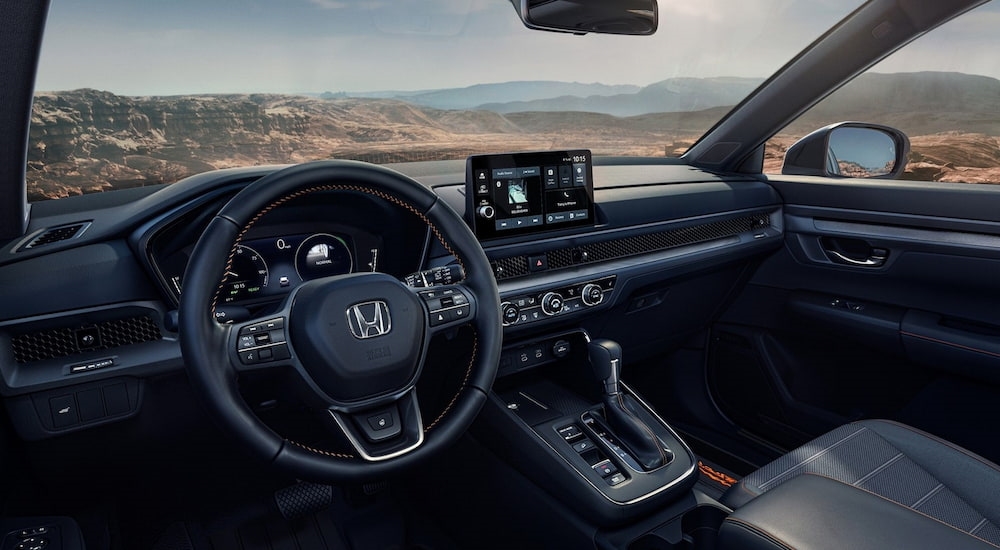
The 2026 CR-V is not a new model; in fact, the current generation debuted in 2022. However, Honda has made necessary updates over the years to keep up with driver preferences and technological updates. For example, the 2026 CR-V includes a standard nine-inch infotainment touchscreen.
This may sound small when compared to competitors' screens, but many drivers agree that functionality is more important than size. The Honda infotainment system is familiar, and while the technology continues to evolve and become more innovative over time, the basic operations of adjusting cabin temperature or finding your favorite driving tunes are intuitive to drivers who have driven a Honda in the past.
Wireless Apple CarPlay and Android Auto connectivity are also wireless across the 2026 CR-V's trim lineup, along with wireless phone charging. Interestingly, not all RAV4 trims are equipped with wireless device charging; this is a significant disparity that sees any 2026 CR-V instantly look better by comparison.
The RAV4 is also all-new for this model year and proudly launches Toyota's brand-new infotainment system, featuring new controls and enhanced capabilities. It stands to reason that there will be a learning curve for this new system, even for long-time RAV4 drivers.
Comfort and Driveability
In matters of cabin design, the 2026 Honda CR-V and the 2026 RAV4 are dynamically different. First, there's the matter of space. Though similar in size, the 2026 CR-V provides 41 inches of legroom to its rear passengers. In the RAV4, rear passengers will find 37.8 inches of legroom in which to stretch their legs.
With all seats occupied in the RAV4, there's still room for 37.8 cu.ft. for gear and groceries, which falls just shy of the 39.3 cu.ft. behind the rear seats of the CR-V. It might not seem like a lot of extra space, but anyone who has had to pack their cargo area like a puzzle knows it's a game of inches.
Furthermore, all 2026 CR-V models have a maximum cargo capacity of 76.5 cu.ft. with the rear seats folded. With the seats down, all 2026 RAV4 models have a maximum cargo capacity of just 70.4 cu.ft.
Honda has also installed body-stabilizing seats on each CR-V. These seats are ergonomically designed to reduce body fatigue and help passengers find better posture on long car trips. Combined with a responsive powertrain, nimble steering, and a braking system that feels natural and appropriately responsive, many drivers find the Honda CR-V to be a quieter, more comfortable drive than the RAV4.
Why Drivers Prefer the 2026 Honda CR-V
When looking at hybrid performance alone, it's easy to see why the Toyota RAV4 thinks it can chase the crown in the compact SUV segment. However, there's more to a car than mere horsepower, and the 2026 Honda CR-V demonstrates that "all-new" doesn't necessarily mean "better."
While the 2026 Toyota RAV4 is an excellent start to a new generation of a familiar model, there are plenty of reasons why you might want to try out the 2026 Honda CR-V first, especially if you value comfort and getting what you want over brand-new technology.